Heat Recovery Technologies for Sustainable Plastic Processing
A production supervisor at a large extrusion facility once described waste heat as ‘money floating through the roof.’ It was a simple observation, but it captured a problem that exists across much of the plastics industry.
Walk through almost any processing plant and the signs are easy to notice. Compressor rooms run hot even during winter months. Warm air leaves ventilation systems continuously. Cooling circuits pull heat away from equipment only for that energy to disappear from the process entirely.
For years, many facilities accepted those losses as part of manufacturing.
That approach is changing.
Energy costs are no longer viewed as background operational expenses. They now influence investment planning, production strategy, and even customer relationships. For some, processors are being required to show energy reductions in order to sign long-term supply contracts.
This escalating demand is driving manufacturers to consider the flow of thermal energy in their plants. Companies are now looking at the amount of useful heat that is lost from the process each day, rather than just efficiency being investigated.
The conversation has gradually shifted from energy consumption to energy recovery.
| Also Read: Maintenance Strategies for Plastic Processing Equipment |
Across extrusion plants, injection molding operations, and polymer compounding facilities, recovery systems are being introduced to capture excess heat and redirect it toward practical applications inside the plant. Waste is now treated as a valuable resource in the process of operation rather than what was once thought of as waste.
Plastic manufacturers are facing ever increasing pressures to cut their energy use without sacrificing productivity, product quality or operational efficiency. Energy costs are always fluctuating and sustainability is increasingly on the boardroom agenda, so manufacturers are reconsidering their use of energy in manufacturing plants. One area receiving significant attention is heat recovery.
Plastic processing operations consume large amounts of thermal energy every day. Extrusion lines, injection molding systems, dryers, compressors, and cooling units all generate heat during production. A significant amount of this heat is wasted in many facilities, either being lost to the atmosphere or being rejected via cooling systems. Recovering and reusing this energy is a significant opportunity for manufacturers to reduce energy use and decrease environmental impact.
Today, the use of Heat Recovery in Plastic Processing is not considered a sustainable option anymore. It has become more and more a viable business solution that helps achieve energy savings, carbon reduction targets and long-term business resilience.
Energy efficiency is important in plastic manufacturing for many reasons.
There are many reasons why energy efficiency is important in plastic manufacturing.
No other industrial process uses as much thermal energy as plastics processing. In most facilities energy consumption is always high, from melting polymers to drying engineering resins, maintaining mould temperatures, to running the extrusion systems during night shifts.
In many processors' businesses, the cost of utilities is a big problem for profitability as well as the price of raw materials. This has given a higher ranking to energy management on the list of operational concerns.
Meanwhile, the expectation for sustainability is evolving throughout the supply chain. Trying to reduce emissions, improve environmental performance and increase manufacturing efficiency are becoming criteria with which global brands accept or reject suppliers. This means plastics manufacturers are being challenged, not only in terms of more efficient production, but to show tangible reductions in energy waste.
Here, energy efficiency in Plastics Manufacturing takes on new significance.
Rather than as a waste heat, manufacturers are starting to see it as a usable, renewable heat source. Extrusion barrels, compressors, cooling systems and molding equipment generate heat which can often be utilized for other plant processes.
In other words, the same energy that can be applied when manufacturing can be applied somewhere else within the plant. This mindset change is propelling more Industrial energy optimization programs in today's manufacturing facilities.
The sources of waste heat in plastic processing facilities are as follows
Plastic processing operations generate heat almost continuously.
Some of it is intentional and necessary for production. Large amounts of thermal energy are required to melt polymers, maintain tooling temperatures, dry engineering resins, and stabilize processing conditions. The issue is not heat generation itself. The issue is how much of that energy leaves the process unused.
In many facilities, recoverable heat comes from areas operators may overlook during day-to-day production.
Extrusion lines release heat through barrels, gearboxes, and cooling systems. Injection molding machines generate thermal energy through hydraulic circuits and motor systems. Compressors produce substantial heat during air compression, while dryers and ventilation units discharge warm air for hours at a time.
Individually, these losses may appear manageable. Across an entire facility operating multiple shifts, however, the energy waste becomes significant.
That's why Industrial Waste Heat Recovery Systems are being looked at more and more in manufacturing, where attention is turning to how to make the most of long-term efficiency.
Instead of upgrading to a larger heating system to meet the energy needs of other parts of the plant, processors are looking to make use of the energy they are already generating.
How Heat Recovery Systems Work
The idea behind heat recovery is quite simple: heat that is carried away from one process is recovered and is used elsewhere within the facility.
The approach, however, can be quite different in each plant in practice.
Some facilities recover heat from air compressors and use it to warm process water during colder months. Others redirect thermal energy from extrusion operations into resin drying systems. Large plants sometimes connect multiple production areas through centralized recovery networks that balance heating and cooling loads across the site.
The effectiveness of these systems depends on several operational factors, including production schedules, process temperatures, plant layout, and consistency of heat generation.
Older facilities often lose substantial energy simply because their systems were never designed with recovery in mind. Instead, newer facilities are being developed employing what is called an integrated and Sustainable Plastic Processing Technologies that integrate the idea of energy reuse into the core of the production process, and not just an ancillary part of it.
Ten years ago, recovery was much less practical, which is one of the reasons for the increased speed of the adoption process. Modern controls, automatic monitoring and compact equipment designs have simplified this, particularly for plants seeking to gain efficiency without sacrificing productivity.
Heat exchangers are used in the production process.
Heat exchangers play a role in manufacturing processes.
Heat exchanger is the core of most of the recovery systems. These devices heat two fluids apart but do not allow the fluids to come in direct contact with each other.
Heat exchangers are commonly used in manufacturing because they allow for efficient heat transfer while maintaining a stable process.
In plastics manufacturing, there are a number of different types of heat exchangers.
Plate Heat Exchangers
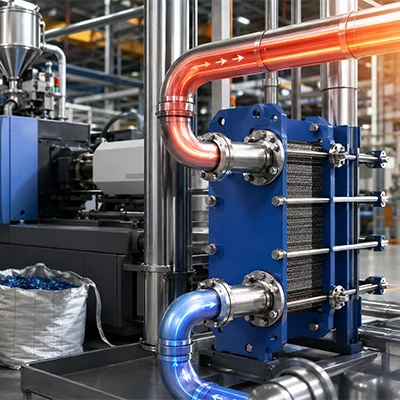
A plate heat exchanger is a type of heat exchanger that has several thin metal plates to transfer the heat between fluid streams. They are compact, efficient and ideal for applications where space is limited.
A plate exchanger is a system often found in injection molding plants that will recover the heat from hydraulic oil systems or cooling systems.
Shell-and-Tube Heat Exchangers
These systems are made up of a series of tubes contained within a larger shell. One fluid passes through the tubes and the other flows round the tubes where heat can be transferred.
Applications such as large extrusion plants and heavy industrial processes often use shell-and-tube systems due to their ability to withstand high temperatures and pressures.
Air-to-Air Heat Exchangers
The heat from warm exhaust air is collected and passed to air streams in an air-based system. Such systems can be especially helpful in facilities with large areas that require ventilation.
Regenerative Heat Recovery Systems
Regenerative systems store heat for a short period of time and then use it again in a process in the production cycle. In today's advanced Sustainable polymer processing, these technologies are gradually gaining importance as techniques that aim at maximizing thermal efficiency.
The type of heat exchanger configuration is determined based on plant size, production needs, maintenance and energy recovery.
Heat Recovery Applications Across Plastic Processing Operations
Heat recovery solutions can be applied across multiple plastic processing methods.
Extrusion Operations
The use of heat recovery systems in plastic processing applications.
Heat Recovery Applications in Plastic Processing Operations.
Recovered heat can be used for:
- Preheating raw materials
- Heating process water
- Supporting resin drying systems
- Maintaining facility temperatures
Because extrusion lines often operate continuously, they provide stable opportunities for Plastic Processing Energy Recovery.
Injection Molding Facilities
There is surplus heat in injection molding machines due to hydraulic systems, motors and mold cooling units.
Recovery systems can capture this energy and redirect it toward secondary plant operations. The total energy saved can be significant for big plants with several molding machines.
Blow Molding Processes
Compressed air systems play a critical role in blow molding operations, as they create a considerable amount of heat during compression.
This heat can be recovered for water heating or other use as warm thermal supports rather.
Resin Drying Systems
Careful drying of engineering plastics may be necessary prior to processing. This recovered thermal energy can be used to assist the drying systems but will also help to lower the extra electricity or fuel use.
Central Utility Systems
More and more centres are now incorporating Thermal energy recovery systems into their plant utilities.
This will enable heat generated in one process area to be utilized in other areas of the facility enhancing the overall energy distribution system.
Financial Benefits of Heat Recovery Investments
Sustainability initiatives are often assessed from a cost/benefit point of view for many manufacturers. There has been increasing interest in heat recovery technologies as the economic advantage is often realized in a relatively short time.
The biggest benefit is reduced energy usage.
The use of thermal energy already generated in production processes reduces the need for extra fuel or electricity for reusing the thermal energy as a secondary heating need. In continuous processing facilities, even small gains in efficiency can be significant annual savings.
In addition to direct cost savings on utilities, manufacturers also claim operational improvements.
More stable temperature control can help to produce high-quality products, especially in an extrusion and injection molding process, where the product quality is influenced by temperature variation. Thermal balance improvements may also help to decrease boiler, chiller, HVAC system strains, decreasing upkeep demands in the long run.
Energy price volatility is another factor of importance. When a facility has a good Plastic Processing Energy Recovery system, it is less likely to be adversely impacted by or to experience sudden increases in electricity or fuel costs since it's utilizing more internal energy.
Sustainability reporting is also having an impact on investments
Energy efficiency and reduction of emissions are increasingly expected by the large industrial buyers of suppliers. Waste Heat Recovery Systems can enable companies to gain a competitive edge in the following scenarios: when accessing tenders, conducting sustainability audits and considering longer-term supplier contracts.
Many processors no longer see heat recovery as an environmental program, because of this. It has been more and more integrated into a broader approach to operations management for the long term that is cost-effective, efficient and resilient.
Sustainability and Environmental Impact
There has been a significant shift in the discussion on plastics manufacturing in the past few years.
Issues of speed and material performance are no longer the only issues being discussed, but environmental issues are a consideration in almost all long-term investment decisions. Manufacturers are being encouraged to demonstrate their efforts to reduce emissions, improve efficiency and reduce the amount of resources consumed in their business.
Heat recovery supports these objectives in a practical way.
Recovery systems enhance the efficiency of the existing production process, as opposed to other types of sustainability efforts, which may involve adopting completely new production processes. Without any changes to essential manufacturing processes or affecting production capacity, facilities can reduce energy consumption.
This is especially useful in energy intensive areas that have high levels of heating and cooling needs, such as a warehouse.
A decrease in external energy demand also leads to a decrease in emissions from electricity generation and fuel combustion. These reductions are in addition to overall environmental goals for companies with formal decarbonization targets.
Many processors are also finding that making improvements for sustainabilty and making the operation more efficient are increasingly intertwined. The range of projects that are approved for cost reduction are now being integrated into broader ESG and sustainability reporting frameworks.
The expectation from customers, investors and regulators is on the rise, and Waste heat utilization technologies are shifting from an optional efficiency improvement to long-term strategic investments.
Smart Manufacturing and Digital Energy Monitoring
The digitalization revolution is driving a change in industrial energy systems' way of working.
Today, there are advanced sensors, automation platforms and real-time analytics tools that enable facilities to better track heat generation and energy usage.
- Modern Industrial energy optimisation solutions often depend on:
- Smart energy monitoring systems
- Predictive maintenance tools
- AI-driven analytics
- Automated thermal controls
- IoT-enabled sensors
- Real-time process visibility
Such technologies enable manufacturers to detect energy losses earlier, and optimize the efficiency of energy recovery systems.
For instance, AI software can optimize thermal recovery operations automatically by taking into account production requirements, temperature variations, and equipment efficiency.
As smart manufacturing technologies continue to evolve, heat recovery systems are expected to become even more intelligent and adaptive.
Challenges Associated with Heat Recovery Implementation
Despite the benefits, implementing heat recovery infrastructure is not always straightforward.
Initial Investment Costs
Installing recovery equipment, piping networks, monitoring systems, and heat exchangers may require significant capital expenditure.
Integration Complexity
Older manufacturing facilities may require extensive modifications to accommodate new recovery systems.
Variable Heat Loads
Some production processes generate inconsistent heat volumes, making recovery optimization more difficult.
Maintenance Requirements
Heat exchangers and thermal transfer systems require regular inspection and cleaning to maintain performance.
Technical Expertise
Successful implementation depends on accurate system design and thermal analysis.
However, improvements in modular system design and automation technologies are helping manufacturers overcome many of these challenges more effectively.
Future Trends in Heat Recovery Technologies
The next phase of heat recovery development is expected to focus heavily on smarter automation, improved thermal efficiency, and greater integration with digital manufacturing systems.
One area seeing rapid advancement is industrial heat pump technology. These systems can capture low-grade waste heat and convert it into higher-temperature energy suitable for reuse in manufacturing operations. This makes recovery systems more effective even in facilities where excess heat was previously considered too weak to reuse efficiently.
Thermal storage is another growing area of interest
Instead of using recovered heat immediately, manufacturers are exploring systems capable of storing thermal energy and redistributing it during periods of peak demand. This approach can improve energy flexibility and reduce pressure on utility infrastructure.
Artificial intelligence is also beginning to influence plant-wide energy management.
Advanced analytics platforms can monitor production conditions in real time, identify energy losses, and automatically adjust recovery operations for improved efficiency. In larger facilities, these systems may eventually coordinate heating, cooling, ventilation, and production energy usage through centralized digital platforms.
At the same time, recovery equipment itself is becoming more compact and modular. Smaller systems are making Sustainable Plastic Processing Technologies more accessible for mid-sized manufacturers that previously viewed heat recovery as practical only for large industrial operations.
Many manufacturers are also combining Waste heat utilization technologies with renewable energy projects such as solar power installations and electrified processing systems. The goal is not simply to reduce energy consumption, but to build more resilient and lower-emission manufacturing environments.
As sustainability targets become more aggressive across global industries, the role of Thermal energy recovery systems in plastics manufacturing is expected to expand significantly over the coming years.
Conclusion
Heat recovery is no longer being discussed only as an environmental initiative.
Inside modern plastics facilities, it is increasingly tied to operational efficiency, cost management, and long-term competitiveness. As energy prices fluctuate and sustainability expectations continue rising, manufacturers are under pressure to improve how energy is used across the production environment.
What makes heat recovery attractive is its practicality.
Most plastic processing facilities already generate large amounts of usable thermal energy during daily operations. Recovery systems simply create a way to capture that energy and redirect it toward productive use instead of allowing it to disappear through exhaust systems, cooling loops, or ventilation infrastructure.
The technologies supporting this shift are also becoming more accessible. Improved heat exchangers, smarter controls, compact recovery systems, and digital monitoring platforms are making implementation easier than it was even a few years ago.
For processors evaluating long-term sustainability strategies, Heat Recovery in Plastic Processing offers a realistic path toward lower energy consumption and stronger operational performance without requiring a complete redesign of existing manufacturing systems.
As Sustainable polymer processing continues evolving, companies that invest in Thermal energy recovery systems and broader Industrial energy optimization strategies are likely to gain advantages not only in energy efficiency, but also in resilience, compliance, and overall production economics.
 Media Pack Download
 Newsletters
 Industrial Events