Overview of Primary Plastics Processing Machinery Used in Modern Manufacturing
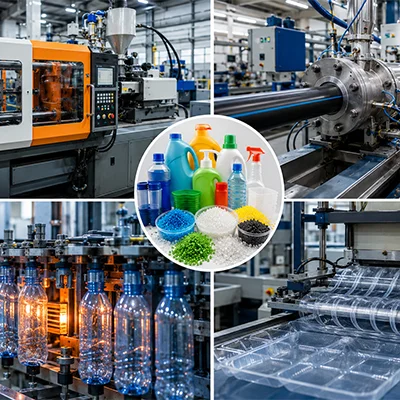
The making of plastic has evolved much more complicated than many expect to imagine outside the industry. The normal everyday products found at stores will go through several well-controlled production stages before being shipped. Whether it's a food tray, a detergent bottle, an auto part, a medical piece, or an electrical housing, the machines involved in these operations are incredibly precise in seconds.
Factories involved in industrial plastic production are also operating under different conditions compared to a decade ago. Earlier, processors mainly concentrated on output numbers. If machines produced enough parts during a shift, the production line was considered successful. That mindset has gradually changed.
Today, manufacturers spend as much time talking about reducing scrap, how much electricity is being consumed, downtime, and the lack of labor as they do on production volume, and process stability. This is why businesses are still investing in new Plastics Processing Machinery to enable better monitoring capabilities, faster cycle control, and less manual involvement.
Modern Plastic Manufacturing Equipment is also different from the previous factory environments. Increasingly, the production plant is not depending solely on the vision of the operator for inspection, but on automated inspection systems, robotic handling units, central monitoring dashboards and digital process control.
In the plastics industry, four technologies are prevalent in most production operations:
- Injection Molding Machines
- Extrusion Machines for Plastics
- Blow Molding Equipment
- Thermoforming machines
These machine categories have existed for years, though the expectations surrounding them continue evolving.
Production Requirements Are Changing
Today, commercial and operational pressures are a challenge for plastic processors.
Leaders have to offer reduced lead times, lower prices and uniform product quality. Processors meanwhile are grappling with rising electricity prices, price volatility of raw materials and sustainability requirements that impact buying across the factory.
For this reason, investments in machinery now are no longer solely determined by the rate of production.
Packaging manufacturers may be very concerned with the lightweighting capability and the materials saved. Automotive suppliers typically are more concerned with dimensional consistency, which can impact the fitment of the assembly. Medical manufacturers often place greater emphasis on process control and clean operating conditions.
Machinery suppliers are therefore moving away from standardized equipment configurations. Many systems are now adjusted around application-specific production requirements instead of broad industry categories.
Another noticeable change inside modern factories involves production visibility.
Earlier plants relied heavily on operator experience to identify processing issues. Today, many facilities continuously monitor temperature behavior, cycle performance, pressure consistency, and material flow through digital systems connected directly to production equipment.
That information helps manufacturers identify irregularities before large quantities of rejected products accumulate.
Injection Molding Machines
Injection molding is still one of the most popular manufacturing processes in the plastics industry.
A list of typical products produced with Injection Molding Machines is given below:
- Packaging caps
- Appliance parts
- Electrical housings
- Automotive trims
- Consumer electronics components
- Medical disposables
- Industrial fittings
In large-scale molding facilities, molding departments are frequently operated continuously for several shifts with high demand for molded parts.
How does Injection Molding Technology work?
Injection molding and extrusion machines are still a major part of plastic production; therefore, it is important to understand how these machines are used.
In injection molding process, the polymer pellets are loaded into a hopper and pushed in the heated barrel of the machine. The material is melted and compacted in a rotating screw, and is extruded with pressure into a mould cavity.
Once the cooling is done, the mold is opened and the part is ejected.
In principle, the process is fairly easy, but it needs to be monitored in the production conditions. Operators should monitor the mold temperature, cooling rate, injection pressure and resin flow to detect the small deviation in these parameters have effect on product quality.
High complexity of the process control systems is more important to the success of molding than ever before. Some more modern machines are able to adjust processing parameters automatically while processing rather than waiting for manual adjustment.
Electric molding systems are another trend to watch, as they become more popular.
While hydraulic machines are still used in many industrial applications, electric systems are gaining popularity as a more cost effective method of machine motion because of their generally lower energy consumption and smoother machine motion at high speed.
Manufacturers supplying medical and electronics sectors often prefer electric systems because they support high-precision manufacturing and cleaner production environments.
Extrusion Machines for Plastics
Extrusion operates differently from molding because production runs continuously rather than one part at a time.
Extrusion Machines for Plastics are widely used to manufacture:
- Plastic pipes
- Packaging films
- Tubing
- Plastic sheets
- Window profiles
- Wire insulation
- Industrial panels
Many extrusion lines run continuously for long production periods, especially in packaging and pipe manufacturing facilities.
The Plastic Extrusion Process
The polymer material is fed into the machine via a feeding hopper and the Plastic extrusion process starts. Inside the barrel, the material is pushed by a rotating screw and the resin is slowly melted by heaters. The molten plastic is then extruded through a shaping die, which gives the final shape to the plastic.
Cooling systems stabilize the material before downstream handling begins.
The overall process itself has remained fairly familiar over the years, though the machinery supporting it has become considerably more advanced.
Modern extrusion systems often include automated feeding controls, inline thickness monitoring, gravimetric dosing systems, and digital process monitoring tools designed to improve consistency during long operating cycles.
Another area of great interest throughout the extrusion industry is recycled material processing.
It's not always easy to be certain of running recycled resin due to the fact that moisture content, contamination and melt may change batch to batch.
Hence, the manufacturer of the equipment is still making changes to the extruder screw, filter and feeding system to stabilize the performance of the equipment during the process of recycling.
As demands for recycled-content keep rising around the world, packaging manufacturers are particularly interested in these improvements.
Blow Molding Equipment
The principal applications of Blow Molding Equipment are hollow plastic products like bottles, drums, storage containers, and fuel tanks.
Blow molding systems are still the top consumer in the packaging industry as the demand for PET bottles and light weight containers continues to rise.
Inside beverage production plants, blow molding machines are often among the fastest-running systems on the production floor.
How Blow Molding Works
Extrusion blow molding is a technique that extrudes plastic to form a hollow tube called a parison. A mold closes around the material while compressed air expands it against the mold walls.
After cooling finishes, the product moves to downstream handling operations.
PET bottle manufacturing commonly uses injection stretch blow molding because the process improves clarity and structural performance.
Modern blow molding operations place heavy focus on production consistency.
Large packaging facilities cannot afford extended downtime caused by unstable bottle quality or machine interruptions. For this reason, many newer systems use automated inspection technologies.
Some production lines now include camera-based monitoring capable of identifying dimensional inconsistencies, wall-thickness variation, and surface defects during operation itself.
Leak testing systems are also becoming increasingly common in high-volume packaging environments.
Recycled PET processing presents another challenge.
Bottle manufacturers are still working on recycled content, but recycled resin is not always on the rules in the factory. Heating systems, airflow management and process monitoring software are being upgraded by machinery suppliers for enhanced stability.
Thermoforming Machines
Thermoforming machines continue playing an important role in lightweight packaging production.
The process is to heat a plastic sheet to a temperature hot enough to mold over the surface of a mold.
Thermoforming is widely used for:
- Food trays
- Blister packaging
- Disposable containers
- Refrigerator liners
- Medical packaging
- Automotive interior panels
Thermoforming typically has lower tooling costs and quick production speeds, compared to several other plastics processes.
This combination makes it attractive for high volume packaging operations.
Current Thermoforming Developments
Over the past few years, there have been even greater advances in the automation of thermoforming systems.
Many production lines now include robotic stacking systems, automated sheet feeding, inline trimming equipment, and inspection systems designed to reduce manual handling.
Energy efficiency is another larger consideration for the design.
With newer thermoforming machines, the newer and more sophisticated heating controls are increasingly helping to lower electricity consumption and keep forming consistent while doing so.
Manufacturers are also trying to use less material, by using thinner sheets of plastic without compromising on strength.
For this reason, equipment manufacturers are still working on new designs of thermoforming systems for lightweight and recyclable materials.
Automated Plastics Manufacturing
Automation is not just for big factories in the multinationals.
In addition, mid-sized processors are getting up to date with modernizing operations as labor shortages and delivery pressures continue to plague manufacturing environments.
A production line that once depended on several operators can now function with limited manual involvement.
Robotic handling systems remove molded parts, conveyors transfer products between stations, and automated inspection systems identify defects before packaging begins.
Many factories now monitor production through centralized dashboards displaying:
- Machine utilization
- Downtime trends
- Material usage
- Power consumption
- Cycle performance
- Temperature variation
The advantage is not only higher speed. Automated plastics manufacturing also improves consistency during long operating periods.
Predictive maintenance is a recent priority, too.
Rather than a breakdown, manufacturers now use sensor data to assess maintenance risks earlier. Repairs can then be scheduled before downtime interrupts production.
Integrated production cells are also becoming more common. The molding, trimming, inspection and packaging is moving towards being a single process, not separate processes with separate workflows.
Sustainability and Energy Efficiency
The plastics sector is seeing an increasing number of equipment purchases that are sustainable. Processors regularly ask machinery suppliers about:
- Energy efficiency
- Scrap reduction
- Cooling performance
- Recycled material compatibility
- Maintenance requirements
For manufacturers, these concerns are practical as much as environmental because energy usage and material waste directly affect operating costs.
As a result, the latest plastics processing equipment and technologies 2026 place strong emphasis on operational efficiency.
Machinery suppliers are introducing systems with servo-driven motors, improved cooling designs, advanced insulation systems, and software capable of monitoring material usage during production.
Some systems can even identify process drift automatically before defective production increases.
Recycled polymer handling remains another major focus area because recycled materials often behave less consistently than virgin resin.
To improve production stability, machinery suppliers continue redesigning filtration systems, extrusion components, and feeding controls.
Future Outlook for Plastics Processing Machinery
The plastics industry continues to evolve toward "connected manufacturing.
Factories increasingly want machinery capable of:
- Real-time monitoring
- Faster production changeovers
- Reduced operator dependency
- Lower energy consumption
- Automated quality correction
- Better production visibility
AI is also starting to impact production management in predictive maintenance and inspection applications.
Manufacturers are looking to detect any process instability instead of being forced to react after defects are discovered, to minimise downtime and material losses.
Across industrial plastic production, the direction is fairly clear. Manufacturers desire systems that can be more easily monitored, flexible, and achieve more stable output with reduced manual control.
The supporting technology will also evolve with the introduction of automation, monitoring software and connected production systems to Injection Molding Machines, Extrusion Machines for Plastics, Blow Molding Equipment and Thermoforming machines, which will continue to play a key role in manufacturing processes.
 Media Pack Download
 Newsletters
 Industrial Events